Asbestos Encapsulation
When asbestos-containing materials are in good condition and removal is not immediately necessary, professional encapsulation seals fibres in place and prevents release — providing a safe, documented, and legally compliant management solution.
Pro Asbestos Removal provides penetrating and bridging encapsulation services for domestic and commercial properties across Surrey, London, and the South East. Our surveyors will assess whether encapsulation or removal is the right solution for your specific situation — and give you an honest recommendation.
Not sure whether to encapsulate or remove? Our surveyors provide an independent assessment and honest recommendation. Call 07345 062075 or book a survey →
Why asbestos encapsulation needs evidence-led planning
Encapsulation can be suitable where asbestos is in sound condition, unlikely to be disturbed and capable of being effectively protected. It is not a substitute for removal where planned work or deterioration will compromise the material. The appropriate first step is usually a condition assessment and documented management decision.
Before work
Check asbestos risk before materials are disturbed.
Material + condition
Both determine whether removal, encapsulation or management is appropriate.
Complete records
Survey evidence and disposal documentation support safe decisions.
The three decisions behind a controlled asbestos encapsulation programme
Identify the material
Confirm the asbestos risk relevant to the condition, accessibility and long-term manageability of asbestos left in place.
02Assess condition and access
Damage, weathering, occupant access and planned disturbance determine the appropriate controls.
03Plan controlled work
The plan should define the work scope, protective controls, waste route and documentation for asbestos encapsulation.
When to act
Before work begins
Arrange evidence before contractors alter the building fabric.
When material is damaged
Restrict access and obtain a competent assessment before cleaning or repair.
Before buying or leasing
Understand asbestos risk before committing to a property or works budget.
When records are absent
A current survey or inspection provides a defensible basis for decisions.
Before disposal
Asbestos waste needs a legal route, appropriate packaging and complete records.
After an incident
Do not disturb suspect debris; arrange an assessment and controlled response.
Relevant work across Surrey, London and the South East
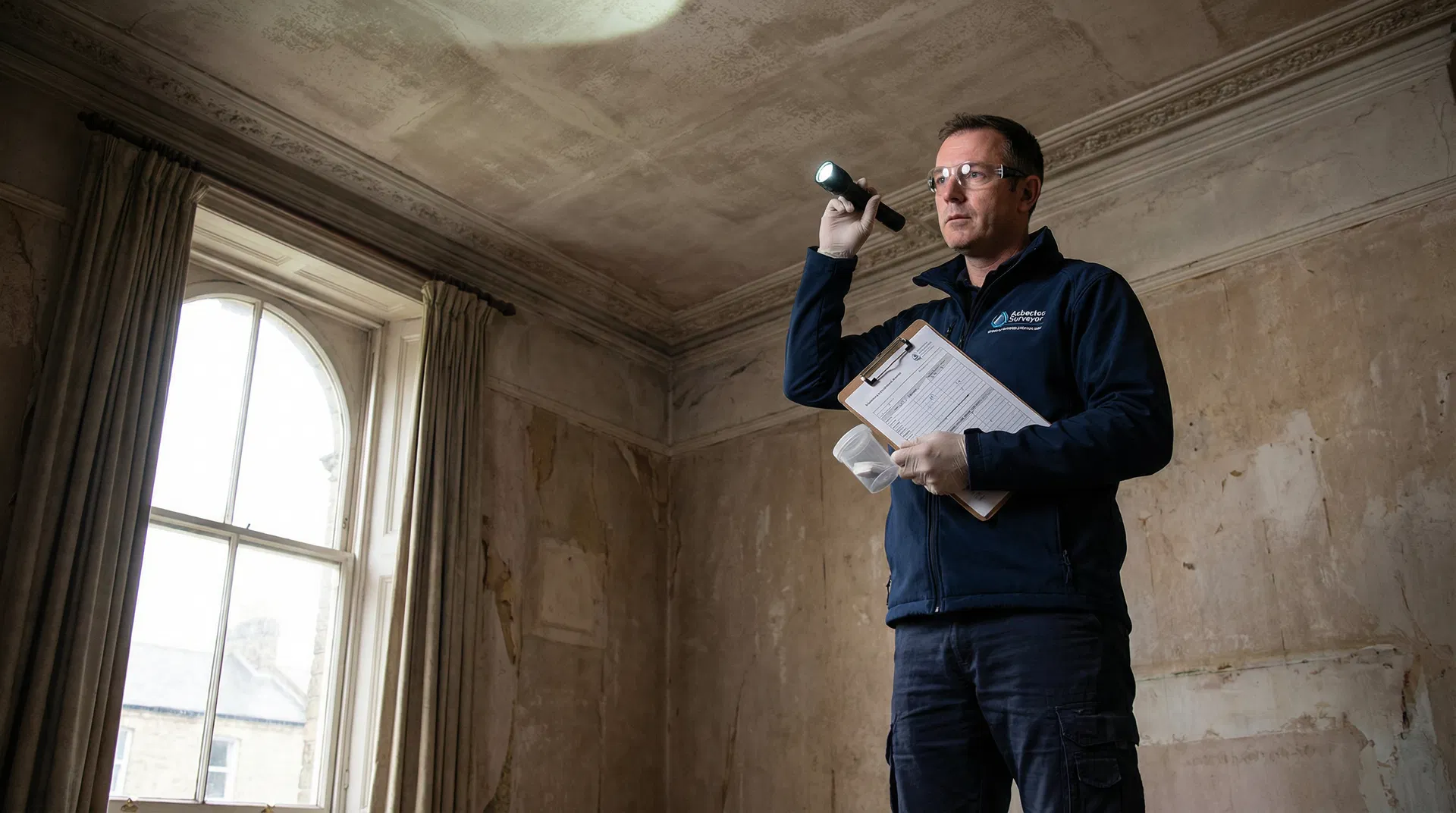

Clear scope. Controlled work. Complete records.
South Croydon Based
A professional framework for planned, controlled asbestos work.
Trained Team
Trained operatives who understand material-specific controls.
Full Documentation
Clear records for surveys, waste and completed work.
Encapsulation Project Gallery
Real photographs from our asbestos encapsulation projects. From material assessment through to sealed surfaces and air monitoring confirmation.
Click any image to view full size · Use arrow keys or swipe to navigate
Asbestos Encapsulation: Sealing Fibres in Place
Asbestos encapsulation is the application of a specialist sealant or coating to an asbestos-containing material (ACM) to bind the fibres within the matrix and prevent them from becoming airborne. The asbestos remains in situ — it is not removed — but the risk of fibre release is significantly reduced or eliminated for the lifespan of the encapsulant.
Encapsulation is a recognised asbestos management strategy under the Control of Asbestos Regulations 2012 (CAR 2012) and the HSE's Approved Code of Practice L143. It is appropriate in specific circumstances — principally where the ACM is in good condition, is not at risk of disturbance, and where a robust monitoring regime can be maintained. It is not a universal alternative to removal, and it is not appropriate for all material types or all situations.
The key distinction from removal is that encapsulation creates an ongoing management obligation. The encapsulated material must be recorded in the asbestos register, inspected at regular intervals, and the encapsulant must be maintained in good condition. If the material is later disturbed — by building works, accidental damage, or deterioration — the encapsulant must be assessed and the management strategy reviewed.
Three Types of Asbestos Encapsulation
Penetrating Encapsulant
A low-viscosity sealant that penetrates the surface of the asbestos-containing material and binds the fibres within the matrix. Suitable for friable or partially damaged materials where the surface is still largely intact. Penetrating sealants are typically used on asbestos insulation board (AIB) and pipe lagging.
Typical applications: AIB panels, pipe lagging, partially damaged spray coatings
Bridging Encapsulant
A thick coating applied over the surface of the asbestos-containing material to form a durable, protective layer. The coating bridges any cracks or surface damage and prevents fibre release. Bridging encapsulants are commonly used on asbestos cement sheets, artex ceilings, and floor tiles.
Typical applications: Asbestos cement sheets, artex ceilings, floor tiles, soffit boards
Enclosure
A physical barrier — such as a false ceiling, cladding, or enclosure panel — installed over the asbestos-containing material to prevent access and fibre release. Enclosure is not strictly encapsulation but is often used in conjunction with it, particularly for pipe lagging and ceiling panels.
Typical applications: Pipe lagging, ceiling panels, wall boards in occupied buildings
When Is Encapsulation Appropriate — and When Is It Not?
The decision between encapsulation and removal is not always straightforward. The following criteria provide a starting point, but a professional assessment by a qualified surveyor is always recommended before a decision is made. Our surveyors provide independent, honest advice — we will recommend encapsulation where it is genuinely appropriate, and removal where it is not.
Encapsulation May Be Suitable
- The asbestos-containing material is in good condition with no visible damage or deterioration
- The material is not in an area subject to regular disturbance, vibration, or impact
- The material will not be disturbed by planned building works in the foreseeable future
- The property owner has a robust asbestos management plan and can monitor the encapsulated material
- Removal is not practicable — for example, where the asbestos is integral to the building structure
- The cost-benefit analysis favours encapsulation over removal for a particular material type
Encapsulation Is Not Suitable
- The material is heavily damaged, friable, or actively releasing fibres
- Building works are planned that will disturb the material
- The material is in a high-traffic area subject to regular impact or abrasion
- The property is being sold and the buyer's solicitor requires full removal
- The material is in a location where monitoring is impractical
- The material is asbestos insulation (thermal or acoustic) in a poor condition — removal is almost always required
How We Carry Out Asbestos Encapsulation
Survey & Assessment
Before any encapsulation work begins, we carry out a detailed assessment of the asbestos-containing material — its type, condition, location, and risk of disturbance. This assessment determines whether encapsulation is appropriate and, if so, which encapsulant type is most suitable. We will also advise on the monitoring regime required after encapsulation.
Surface Preparation
The surface of the ACM is carefully prepared before encapsulant application. Any loose debris or surface contamination is removed using HEPA-filtered vacuum equipment. The surface is then cleaned and, where necessary, primed to ensure maximum adhesion of the encapsulant.
Encapsulant Application
The appropriate encapsulant — penetrating or bridging — is applied to the ACM surface using specialist equipment. Application is carried out by UKATA-certified operatives wearing appropriate PPE. The encapsulant is applied to the manufacturer's specification to ensure full coverage and the required film thickness.
Visual Inspection & Air Testing
Following application, a visual inspection confirms that the encapsulant has been applied correctly and that full coverage has been achieved. Where required, air clearance testing is conducted by a UKAS-accredited analyst to confirm that airborne fibre concentrations are within safe limits.
Documentation & Register Update
On completion, we provide a written encapsulation record detailing the material treated, the encapsulant used, the date of application, and the monitoring schedule. This documentation is provided in a format suitable for inclusion in your asbestos register and management plan.
The Legal Framework for Asbestos Encapsulation
Asbestos encapsulation is governed by the Control of Asbestos Regulations 2012 (CAR 2012) and the HSE's Approved Code of Practice L143. Regulation 4 of CAR 2012 requires duty holders in non-domestic premises to manage asbestos — which includes maintaining an asbestos register, assessing the condition of ACMs, and implementing a management plan. Encapsulation is one of the management options available under this framework.
For domestic properties, there is no statutory duty to manage asbestos in the same way — but the duty of care under the Health and Safety at Work Act 1974 and the Environmental Protection Act 1990 still applies. Homeowners who are aware of asbestos in their property have a responsibility to ensure it does not pose a risk to others, including contractors, visitors, and future occupiers.
Encapsulation of licensed asbestos materials — including asbestos insulation board (AIB), pipe lagging, and spray coatings — requires a licensed contractor under Regulation 8 of CAR 2012. Encapsulation of non-licensed materials, such as asbestos cement sheets and artex, does not require a licence but must be carried out by a competent person.
Asbestos Encapsulation Across Surrey, London & the South East
We provide asbestos encapsulation services across a wide area of Surrey, South London, and the South East. Our team is based in Croydon and typically responds within 24–48 hours across our core coverage area.
View all service areas →Common Questions About Asbestos Encapsulation
Get Your Free Quote Today
No obligation. We'll assess your encapsulation requirements and provide a clear written quote — usually within 24 hours.
REQUEST A FREE QUOTE → Call 07345 062075Not Sure? Book a Survey First
Our surveyors will assess your asbestos-containing materials and give you an honest recommendation — encapsulation, removal, or management in place.
Book an Asbestos Survey →Speak to an Expert
Available Mon–Sat 8am–6pm. Emergency line available.
07345 062075✉ info@proasbestosremoval.comNeed Professional Asbestos Encapsulation?
Free no-obligation quotes · licensed team · Full documentation & register update included