Pre-Acquisition Asbestos Survey
Buying a commercial property built before 2000 without a pre-acquisition asbestos survey means inheriting an unknown liability. Three-quarters of UK commercial, municipal, and industrial premises contain asbestos — and once contracts exchange, the Duty to Manage passes to the buyer in full.
A pre-acquisition survey identifies every ACM present, its condition, and the estimated cost of management or removal — before exchange. Pro Asbestos Removal provides commercial pre-acquisition surveys across Surrey, London, and the South East, with reports structured for solicitors, investors, and facilities managers.
Duty to Manage liability transfers on exchange of contracts. Failure to comply with CAR 2012 Regulation 4 can result in HSE enforcement, unlimited fines, and personal director liability — even if the ACMs were present before you owned the building.
Why pre-acquisition asbestos surveys needs evidence-led planning
Asbestos risk can affect planned capital works, contractor controls, programme certainty and the future cost of ownership. Early evidence supports better due diligence before a commercial property transaction completes. The appropriate first step is usually a pre-acquisition survey and prioritised risk report.
Before work
Check asbestos risk before materials are disturbed.
Material + condition
Both determine whether removal, encapsulation or management is appropriate.
Complete records
Survey evidence and disposal documentation support safe decisions.
The three decisions behind a controlled pre-acquisition asbestos surveys programme
Identify the material
Confirm the asbestos risk relevant to known and reasonably accessible asbestos risks that may affect acquisition or planned investment.
02Assess condition and access
Damage, weathering, occupant access and planned disturbance determine the appropriate controls.
03Plan controlled work
The plan should define the work scope, protective controls, waste route and documentation for pre-acquisition asbestos surveys.
When to act
Before work begins
Arrange evidence before contractors alter the building fabric.
When material is damaged
Restrict access and obtain a competent assessment before cleaning or repair.
Before buying or leasing
Understand asbestos risk before committing to a property or works budget.
When records are absent
A current survey or inspection provides a defensible basis for decisions.
Before disposal
Asbestos waste needs a legal route, appropriate packaging and complete records.
After an incident
Do not disturb suspect debris; arrange an assessment and controlled response.
Relevant work across Surrey, London and the South East
Clear scope. Controlled work. Complete records.
South Croydon Based
A professional framework for planned, controlled asbestos work.
Trained Team
Trained operatives who understand material-specific controls.
Full Documentation
Clear records for surveys, waste and completed work.
The Commercial Property Asbestos Risk
An estimated 500,000 UK commercial properties still contain asbestos-containing materials (Jude, 2005). For industrial properties, the figure is higher — corrugated asbestos cement roofing, sprayed coatings on structural steelwork, and heavy pipe lagging were standard construction materials throughout the post-war building boom. Asbestos removal accounts for 10% of demolition costs and up to 5% of refurbishment spend (McCloskey, 2020). For a large commercial or industrial property, that is a material liability.
The financial impact extends beyond removal costs. Research published in the Journal of Real Estate Finance and Economics found that anticipated future removal costs and demand reductions from concerned occupants reduce present values and transaction prices even before the asbestos poses any immediate danger (Koehn et al., 1990). A separate study found that asbestos presence depreciates residential property values by 13.44% on average — approximately $25,300 per property (Affuso et al., 2018). For commercial property, the impact depends on the type, quantity, and condition of ACMs, and the cost of remediation.
Poor project planning without prior asbestos information causes significant cost overruns and delays in refurbishment projects. A case study of the London Borough of Hillingdon's four-year asbestos survey programme found that projects setting out with limited ACM information experienced the greatest scope of unforeseen difficulties, risks, delays, and costs (Kupakuwana, 2007). A pre-acquisition survey prevents this by establishing a complete ACM inventory before any works begin.
Common ACMs by Commercial Property Type
Offices & Commercial Buildings
Pre-1980 office buildings commonly contain asbestos insulation board (AIB) in ceiling tiles, fire doors, and partition walls. Sprayed coatings may be present on structural steelwork in older multi-storey buildings.
Industrial Units & Warehouses
Corrugated asbestos cement roofing was standard for UK factories and warehouses from the 1950s to the mid-1980s. Sprayed amosite on structural steelwork is common in buildings from the 1950s–1970s.
Retail & Mixed-Use
Retail properties built before 2000 frequently contain Artex ceilings, asbestos floor tiles, and lagged pipework in service areas. Mezzanine floors and suspended ceilings are common ACM locations.
Healthcare & Education
Schools, hospitals, and care homes built before 1985 have some of the highest ACM densities of any building type. Sprayed coatings, AIB, and pipe lagging are all common, and the Duty to Manage is particularly strictly enforced.
A Complete Due Diligence Report
- Full visual inspection of all accessible areas including plant rooms, roof voids, and service ducts
- Identification and sampling of all suspected ACMs across the entire property
- UKAS-accredited laboratory analysis of all bulk samples
- Detailed ACM register with condition ratings, priority scores, and material assessment scores
- Full written survey report with annotated floor plans and photographs
- Duty to Manage liability assessment for the incoming duty holder
- Estimated removal and management costs for all ACMs identified
- Plain-English executive summary for solicitors and investors
- Advice on whether a refurbishment and demolition survey is also required
- Qualified P402-certificated surveyors — reports delivered within 3–5 working days
From Instruction to Exchange
Instruction & Scoping
We review the property details, construction date, and any existing asbestos information provided by the vendor. A scope of works is agreed with the buyer's solicitor or property agent, and a site visit is booked at a time convenient for all parties.
Site Survey
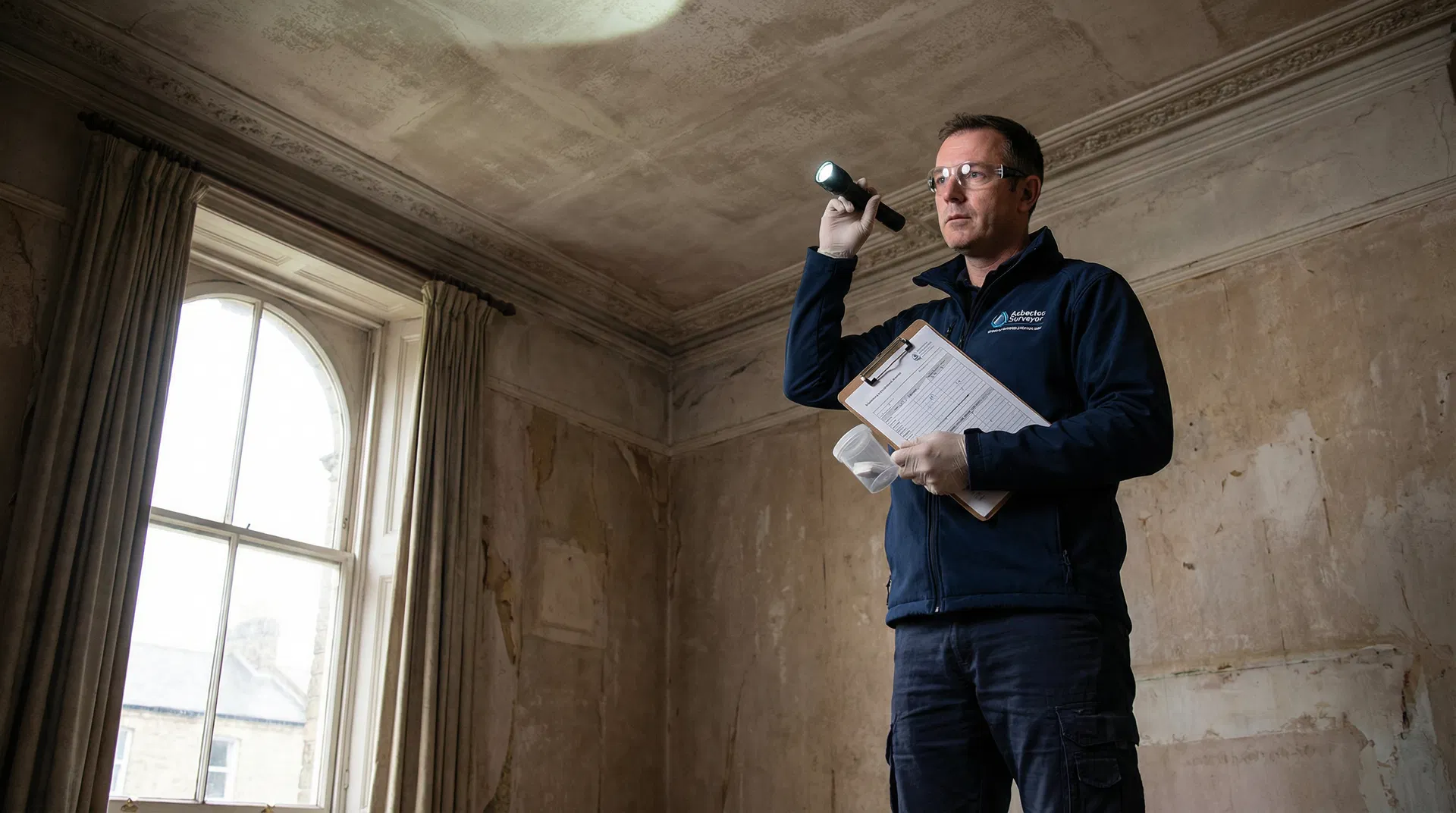
A P402-certificated surveyor carries out a full visual inspection of all accessible areas — including plant rooms, roof voids, service ducts, and any areas of particular concern identified during scoping. All suspected ACMs are identified, recorded, and sampled.
UKAS Laboratory Analysis
All bulk samples are sent to a UKAS-accredited laboratory for polarised light microscopy (PLM) analysis. Results are typically returned within 24–48 hours. Fibre type, percentage content, and ACM classification are confirmed for every sample.
Survey Report & ACM Register
A full written survey report is produced including an annotated floor plan, ACM register with condition ratings and priority scores, photographs of every ACM location, and estimated removal costs. An executive summary is provided for solicitors and investors.
Buyer Briefing & Due Diligence Support
We discuss the survey findings directly with the buyer, solicitor, or property agent. We can provide written confirmation of findings for use in price negotiations, and advise on whether a refurbishment and demolition survey will be required before any planned works.
What Happens After Exchange?
The Duty to Manage asbestos under CAR 2012 Regulation 4 transfers to the new owner on exchange of contracts. The duty holder must have a written asbestos management plan, ensure all maintenance contractors consult the asbestos register before starting work, and keep the register up to date. Failure to comply can result in HSE enforcement, unlimited fines, and personal liability for directors and managers (Jude, 2005). The pre-acquisition survey report forms the foundation of the incoming duty holder's compliance documentation — it is not just a due diligence tool, it is the starting point for ongoing legal compliance.
Common Questions
Is a pre-acquisition asbestos survey a legal requirement for commercial property?
There is no statutory requirement for a pre-acquisition survey, but it is strongly recommended for any commercial property built before 2000. Once contracts exchange, the buyer inherits the full Duty to Manage asbestos under CAR 2012 Regulation 4 — including any liability for ACMs that were present but undisclosed at the time of purchase. A pre-acquisition survey identifies the presence, type, condition, and extent of ACMs before exchange, allowing the buyer to quantify removal costs, negotiate the purchase price, and plan for any required works before taking occupation.
How does asbestos affect commercial property value?
Research published in the Journal of Real Estate Research found that the presence of asbestos-containing materials reduces commercial property value, with the magnitude depending on the optimal strategy for dealing with the ACMs — whether management in place or removal. A separate study found that anticipated future removal costs and demand reductions from concerned occupants reduce present values and transaction prices even before the asbestos poses any immediate danger. For residential property, asbestos presence has been shown to depreciate values by 13.44% on average. For commercial property, the impact depends on the type, quantity, and condition of ACMs, and the cost of remediation.
What is the difference between a pre-acquisition survey and a management survey?
A management survey is the baseline survey required for CAR 2012 Regulation 4 compliance in occupied non-domestic premises. It is a non-intrusive inspection designed to identify ACMs that could be disturbed during normal occupancy and routine maintenance. A pre-acquisition survey is commissioned specifically for a property transaction — it follows the same methodology as a management survey but is scoped to provide the buyer with the information needed for due diligence, price negotiation, and post-acquisition planning. The report is structured for solicitors and investors as well as facilities managers.
Can the survey report be used to negotiate the purchase price?
Yes. If the survey identifies ACMs that require removal or management, the estimated costs can be used to negotiate a reduction in the purchase price, to request that the vendor arranges removal before completion, or to adjust the terms of the transaction to reflect the buyer's inherited liability. We can provide written confirmation of findings and cost estimates specifically for use in price negotiations.
What happens if asbestos is found after contracts exchange?
Once contracts exchange, the buyer inherits the Duty to Manage asbestos under CAR 2012 Regulation 4. Failure to comply with the Duty to Manage can result in HSE enforcement action, unlimited fines, and potential personal liability for directors and managers. The buyer also inherits any liability for ACMs that were present but undisclosed at the time of purchase. A pre-acquisition survey prevents this situation by identifying all ACMs before exchange.
How long does a commercial pre-acquisition survey take?
The duration depends on the size and complexity of the property. A small office unit may take half a day. A large industrial building or multi-storey commercial property may take a full day or more. The written report is typically delivered within 3–5 working days of the survey. We can accommodate urgent timelines where required — contact us to discuss your transaction deadline.
References
- [1] Fisher, J. et al. (2009). Valuation of the Effects of Asbestos on Commercial Real Estate. Journal of Real Estate Research.
- [2] Koehn, M. et al. (1990). Market responses to asbestos in buildings. Journal of Real Estate Finance and Economics.
- [3] Affuso, E. et al. (2018). The external cost of asbestos in the housing market. Applied Economics Letters.
- [4] McCloskey, F. (2020). Methods to safely reduce the costs of managing asbestos. Journal of Building Survey, Appraisal & Valuation.
- [5] Kupakuwana, P.S. (2007). A Critical Analysis of Asbestos Removal Project Cost Implications. Cost Engineering.
- [6] Jude, D. (2005). Managing asbestos risk. Journal of Building Appraisal.
- [7] Dawson, M. (2012). Asbestos in buildings. Journal of Building Survey, Appraisal & Valuation.
- [8] Mann, D. (2005). Asbestos management: Duty holders' responsibilities. Journal of Building Appraisal.
Book a Commercial Survey
Reports structured for solicitors and investors. Delivered within 3–5 working days. Urgent turnaround available.
GET A FREE QUOTE → 07345 062075